Home Work About
Bengaluru ·
Home / Work / Case 05 · SprintMart Shared Cart

One cart.
The whole household.

Role User research, feature research & prototyping
Context IIT Madras mini-project · team of 6
Timeline June 2026 · one sprint
Deliverable React build · 30 screens · 19 components
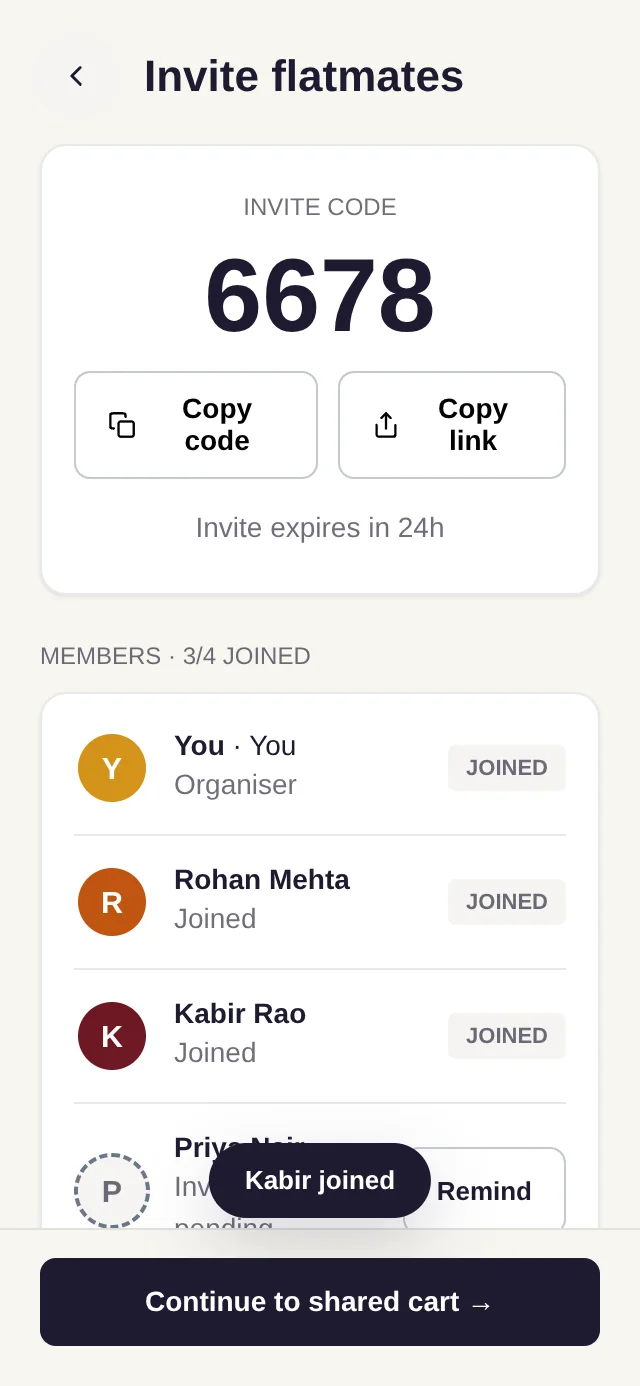
Invite flatmates — members joining the shared cart
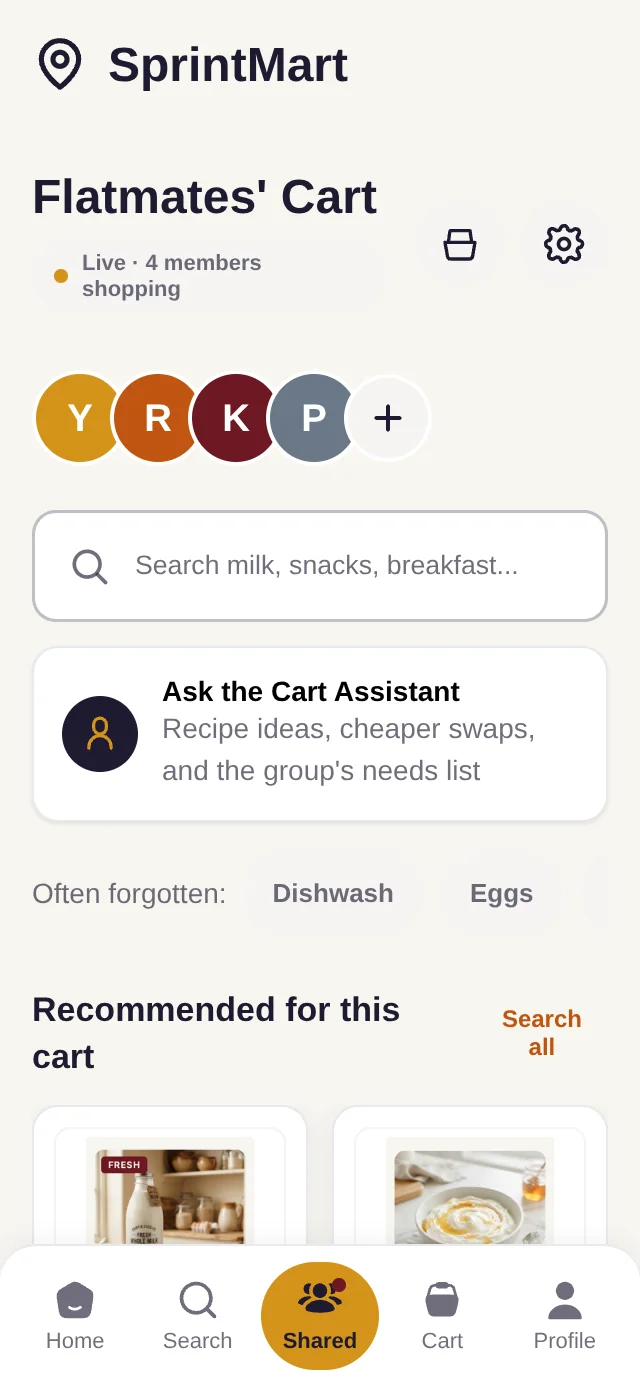
Shared Cart dashboard — four members live in one cart
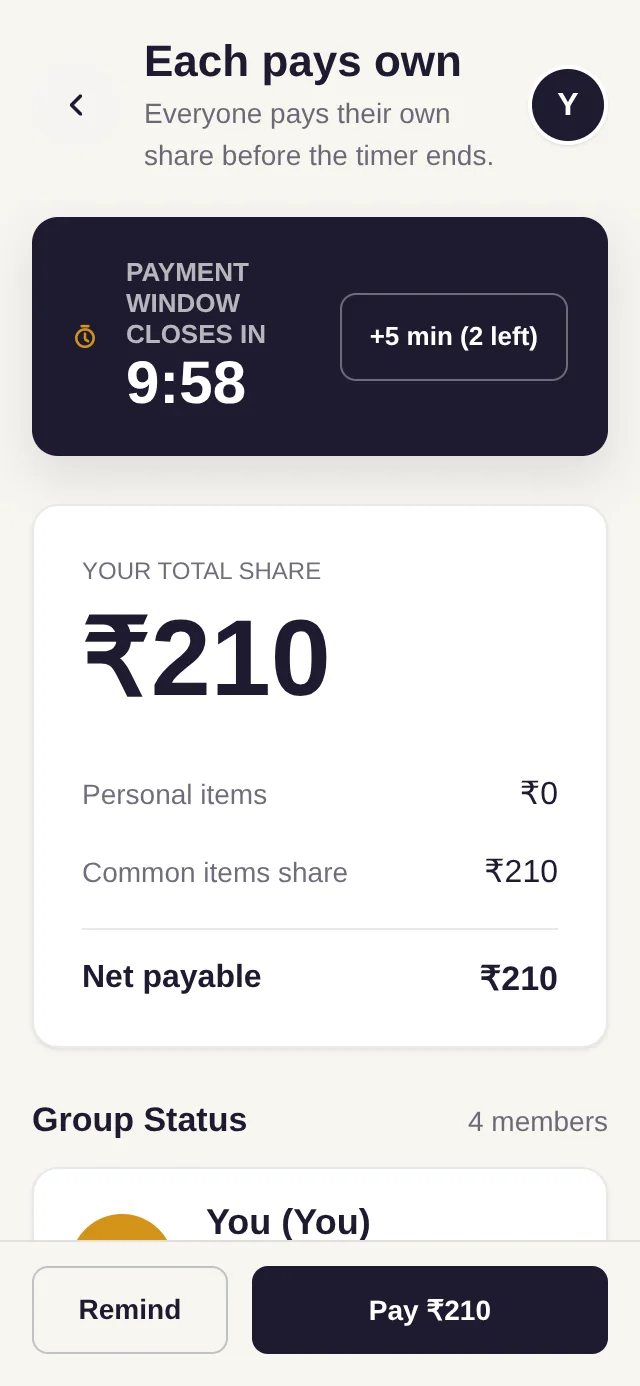
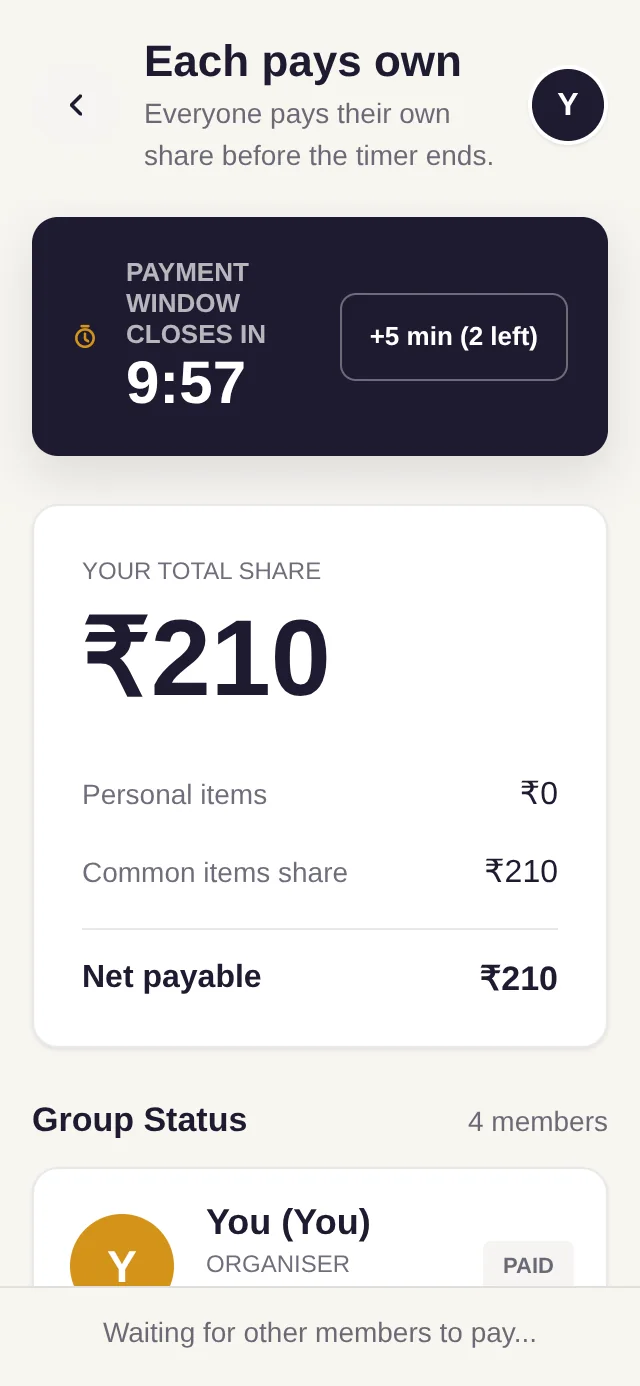
Each pays own — per-member split payment
Fig.01 · The Shared Cart — join · live cart · split & pay
The problem

Watch how a flat
of three orders.

Requests drip into WhatsApp. One person compiles them from memory, orders alone, fronts the bill — then spends two days collecting ₹600s. Every quick-commerce app treats all of that as a single shopper.

The cart, the payment, and the awareness of both live in three different places. I put them on one screen.
The research

What our research
told us.

Six of us split into tracks for the sprint. Mine was household ordering — 12 interviews, a 60-person survey, five real group-order threads read line by line. The rest covered store operations, delivery trust and the base build. These four findings built the feature:

Insight 01 61% Orders are group decisions paid by one person. money must be visible to every member, before checkout.
Insight 02 80% One "default orderer" compiles everyone's items from memory. everyone adds their own — joining must cost nothing, not even a sign-up.
Insight 03 2in 5 A duplicate lands weekly; 78% forget items. guard the add moment itself — two-button checks, never cleanup after.
Insight 04 600×3 Chasing money is social friction; being chased feels like surveillance. settlement is structural — caps, quiet approvals, per-member payment.
“I don't mind ordering. I hate being the house bank.”Interview 07 · a household's default orderer
The multi-user flow

Here's the flow we designed —
two people, one system.

Hover any step — the frame shows its actual screen
Organiser — control without chasing
01Creates the cart
02Picks the payment model — Admin Pays or Each Pays
03Shares the invite code
06Reviews the joint cart as items arrive
10Locks the cart & starts checkout
13Pays the total, or per-member splits go out
Contributor — autonomy without surveillance
04Joins with the code — no sign-up
05Sees the live cart, members and budget
07Adds items — marked common or personal
12Pays their own share via UPI
Done here — the Organiser carries it to checkout
System · carries the friction
05aSyncs the cart live; logs every change
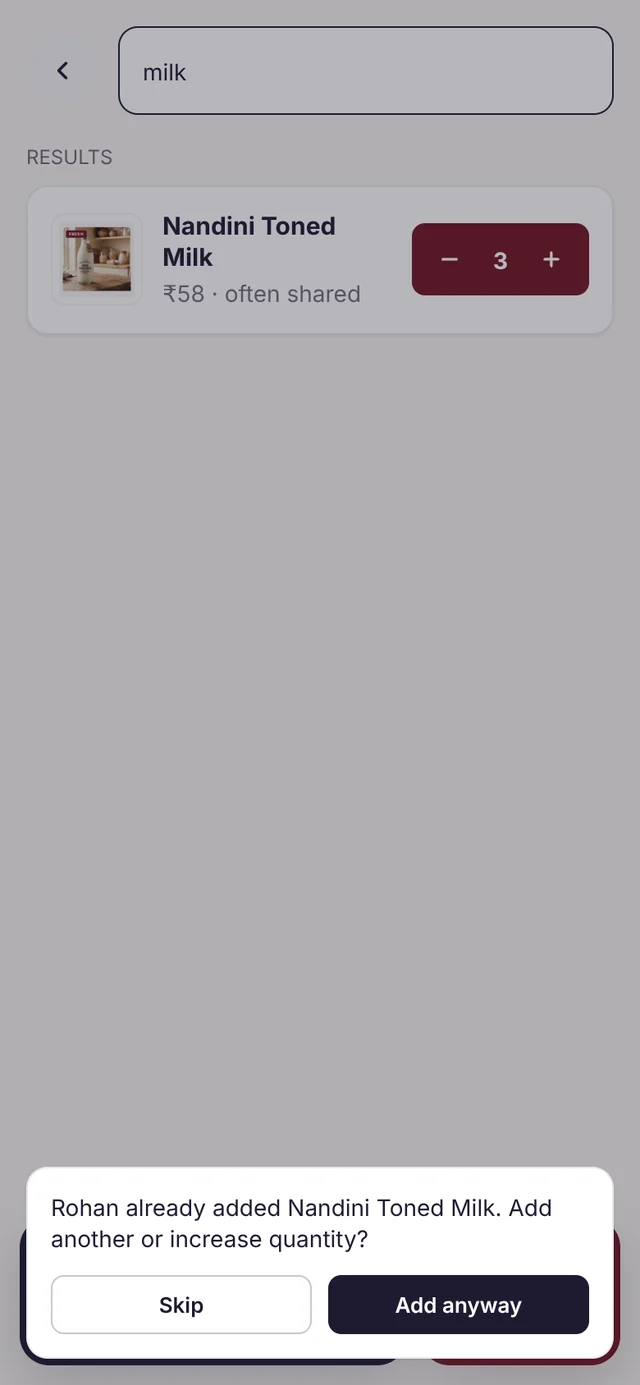
08Catches duplicates — skip, or add anyway
09Updates the household budget bar
11Opens a 10-minute payment window
13Confirms one order — tracked by everyone
The decisions

Four calls I made
to make it work.

Decision 01 · Insight 03 Hick's Law

Duplicates get two buttons. Skip, or add anyway — one tap, never a menu. A contributor with thirty seconds of patience won't open one.

Duplicate guard — skip or add anyway
Decision 02 · Insight 01 Public cap

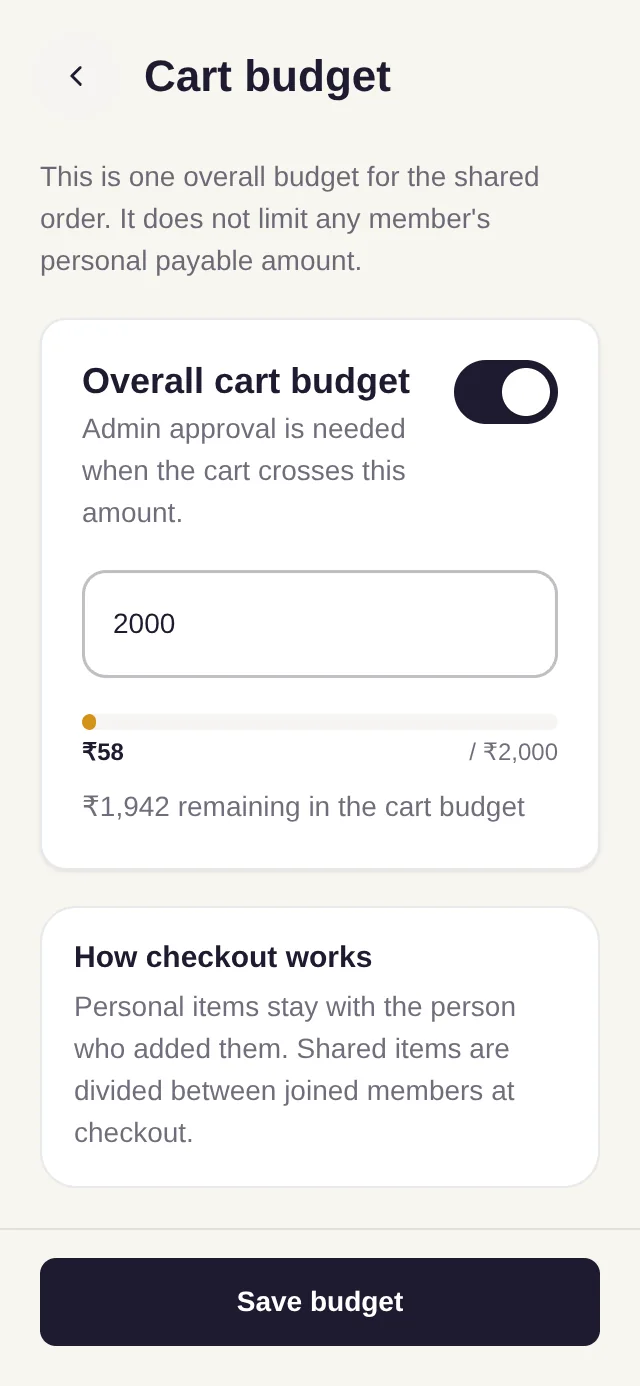
The budget is public. One cap every member sees, editable until the cart locks — never a surprise at checkout.

Edit budget cap screen
Decision 03 · Insight 04 Quiet approval

Over-cap items wait, silently. The Organiser approves or removes; the contributor never sees a call-out.
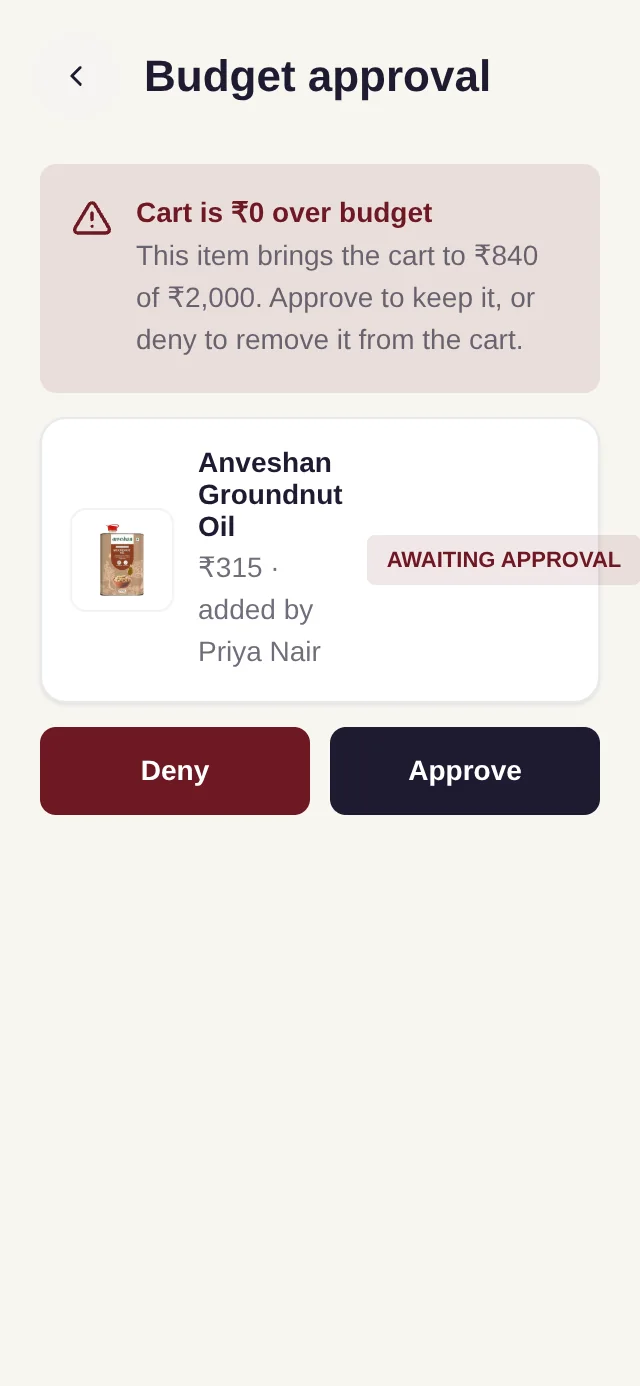
Budget approval pending
Decision 04 · Insight 04 Split & pay

Everyone pays their own share in a 10-minute window. A miss at 9:59 never drops the cart — the Organiser covers the share, and the household still gets its groceries.

Payment confirmed — share settled
The outcome

What I'll claim —
and what I won't.

Straight answer

This is a mini-project — no usage data, and I won't pretend otherwise. What I will claim: a working multi-user feature that Blinkit, Zepto and Instamart don't ship. I checked all three directly.

If it shipped, I'd measure:

Duplicate-guard acceptance Settlement time in the window Orders with 2+ contributors Repeat carts per household
01 Design and build should move together — two screens were designed before they were wired in. Fixed, and noted.
Credit

Who did what,
on what.

My role
Household research track, Shared Cart feature design, design-system tokenization — shipped as CSS variables consumed across the React build — and AI-agent build direction
Team
Five teammates ran the store-operations, delivery-trust and base-app build tracks
Tools
Figma, Stitch, React, Claude-based agentic build pipeline
Program
IIT Madras — UI/UX with Agentic AI & GenAI, 2026
See more work

More design work
where this came from.

Case studies on site · full portfolio on Behance